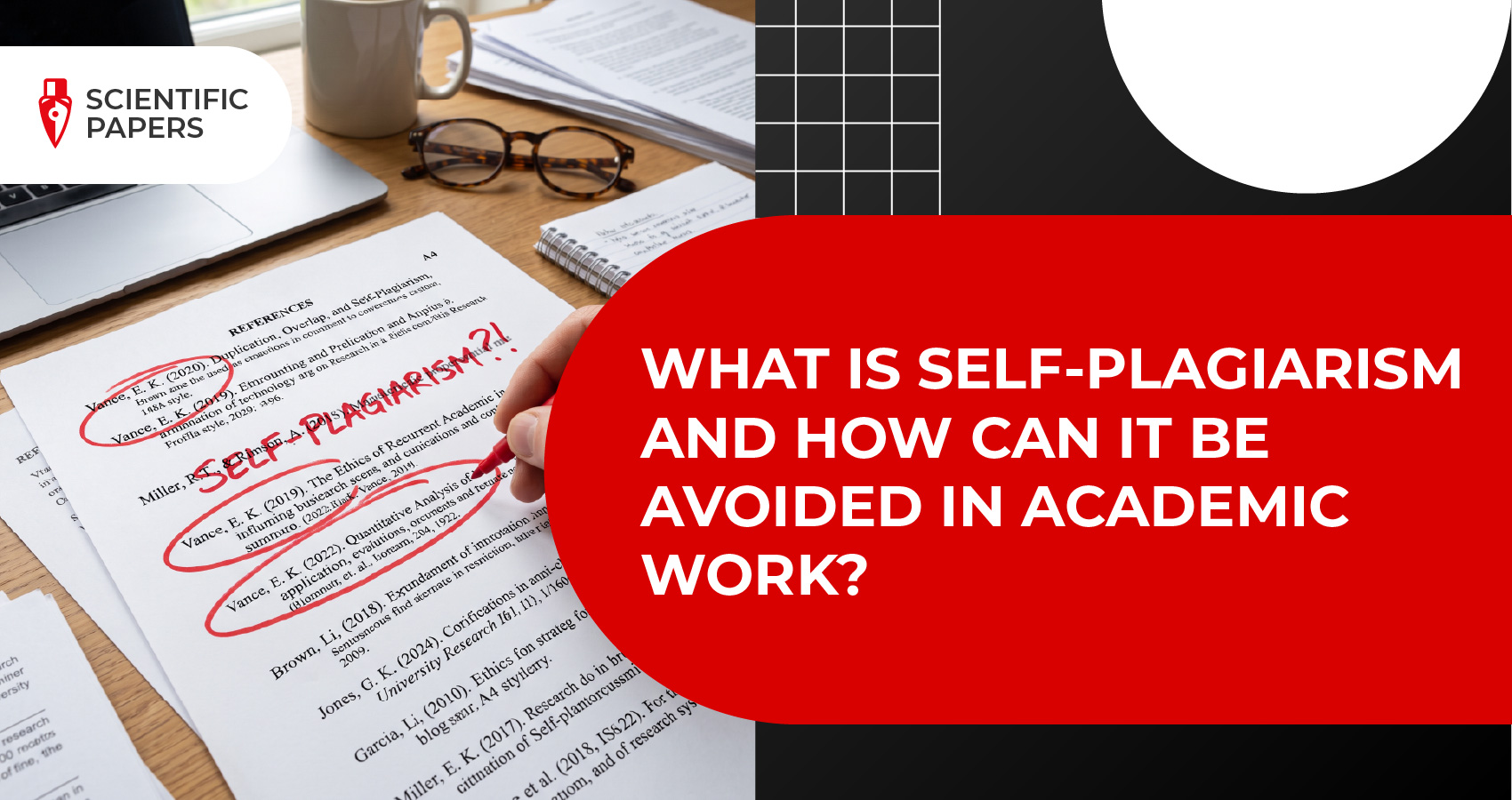
When preparing various academic materials, authors often refer to their own previous research. The use of previously published results is not always a violation in itself, as a new work may logically continue a previous one. The problem arises when a researcher reuses their own texts, data or conclusions without proper citation and presents them as new. This practice is called self-plagiarism and may have serious consequences for the author’s academic reputation.
What is self-plagiarism?
Self-plagiarism is the reuse by an author of their own previously published texts, research results, tables, graphs, images, conclusions or other materials without an appropriate reference to the original source.
In fact, the author does not appropriate someone else’s intellectual work, as in the case of conventional plagiarism, but misleads readers, editors and reviewers regarding the novelty of the material presented. Republished text may create the impression that the research, results or academic propositions are being presented for the first time, although they have in fact already been made public.
Self-plagiarism may involve more than verbatim copying. Minor paraphrasing of previously published material without citation, the reuse of the same data or the submission of almost identical works to different academic publications may also be considered violations.
Main types of self-plagiarism
Republication of the same material
One of the most common types of self-plagiarism is the submission of the same or an almost identical academic paper to several journals. The author may change the title of the article, individual wording or its structure, but the main content, results and conclusions remain unchanged.
The simultaneous submission of the same manuscript to several publications without notifying their editorial teams is a particularly serious violation. Most academic journals require authors to confirm that the work has not been published previously and is not under consideration by another publication.
Reuse of one’s own text
Self-plagiarism may involve the verbatim or almost verbatim transfer of substantial passages from previous articles, dissertations, monographs, conference abstracts or other materials without citation.
Even when an author uses their own text, they must clearly identify its original source. This is particularly important for theoretical sections, literature reviews, descriptions of methodology, research results and conclusions.
Minor overlap in standard wording within the methodology section may sometimes be acceptable, but extensive borrowed passages require paraphrasing, citation and an explanation of their connection with the new work.
Reuse of results and data
An author may use data in a new article that have already been presented in a previous publication. This is not always prohibited, particularly if the new study contains a different approach to analysis, additional results or a new interpretation.
However, the reuse of data must be openly disclosed. The author must refer to the previous publication, explain exactly which materials are being reused and justify the academic novelty of the new work.
The concealed presentation of old results as new may distort academic statistics and create a false impression of the scale of the research conducted.
Dividing one study into several publications
Another form of self-plagiarism is the so-called fragmentation of results, in which one comprehensive study is artificially divided into several small articles. In such a case, each individual publication may contain only a minor portion of the results and may not have a sufficient independent academic contribution. The purpose of such division is often to artificially increase the author’s number of publications.
Dividing a large study into several articles may be justified if each of them examines a separate academic question and has its own objective, methodology, results and conclusions. At the same time, such publications must contain appropriate cross-references.
Reuse of tables, graphs and images
Tables, diagrams, charts, photographs and other visual materials are also part of an academic publication. Their reuse without reference to the original source may be considered self-plagiarism.
Furthermore, copyright in published materials is sometimes transferred to the publisher. Therefore, the reuse of a table or image may require not only a reference but also official permission from the copyright holder.
Why is self-plagiarism considered a violation?
The main problem with self-plagiarism is that it distorts the perception of the originality and novelty of an academic work. Editors and reviewers assess a manuscript on the assumption that it contains new results that have not been published previously.
The duplication of one’s own materials may also artificially increase the author’s number of publications, indicators of their academic productivity and citation count. This contradicts the principles of academic integrity and transparency in academic communication.
Furthermore, the repeated publication of the same data may affect the results of systematic reviews and meta-analyses. If one study is mistakenly perceived as several independent works, this may lead to incorrect academic conclusions.
What may be the consequences of self-plagiarism?
The detection of self-plagiarism may result in the rejection of a manuscript before peer review begins or at any stage of the editorial review process.
If the violation is detected after publication, the journal may publish a correction, a notice of the violation or retract the article. Information about a retraction usually remains publicly available and may negatively affect the researcher’s professional reputation.
Other possible consequences include:
- refusal by the editorial team to consider the author’s subsequent manuscripts
- contacting the author’s university or research institution
- loss of trust among colleagues, editors and reviewers
- disciplinary liability
- problems during the defence of a dissertation or the certification process
- the need to return grant funding in the event of a breach of the terms of a research project
Have you encountered difficulties in preparing an academic material? Contact the company Scientific Papers. Our specialists will assist with structuring, editing and formatting the research in accordance with the established requirements and deadlines. To receive a free consultation, submit an application on the website. Our manager will contact you shortly. Together towards academic achievements!